
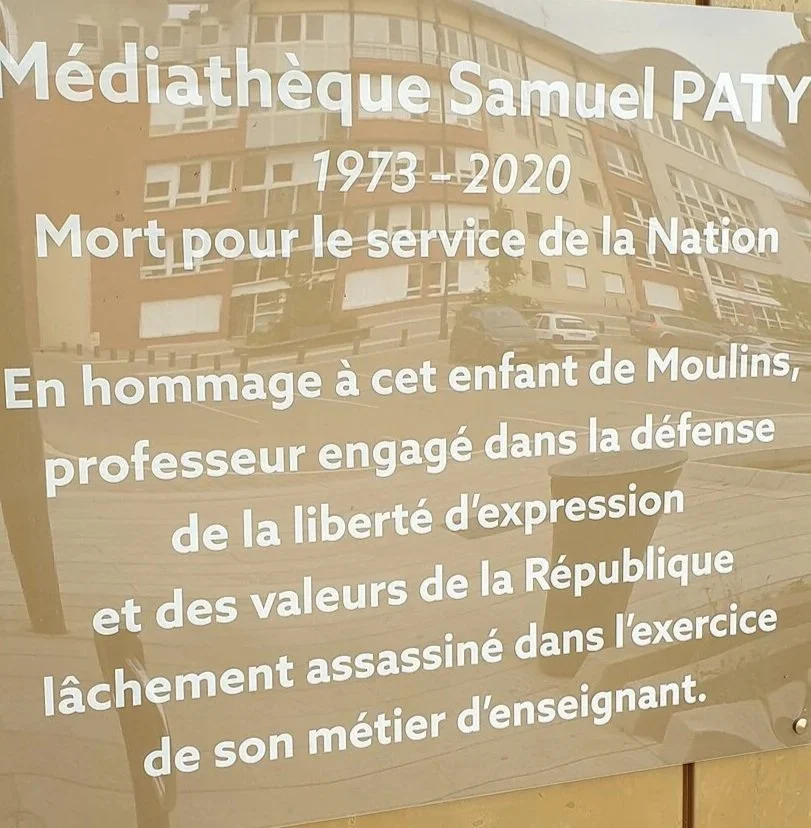
In remembrance of Samuel Paty
October 16, 2026
IT’S the sixth anniversary of the awful beheading of the secondary school teacher Samuel Paty by an Islamist immigrant in the suburbs of Paris. Paty might have shown his students an offensive cartoon featuring the Prophet Muhammad’s dick and bollocks, but even if he’d shouted through a megaphone that Muhammad was a disgusting paedophile, there was no possible justification for his heinous murder.
That Paty’s “blasphemy” could even have been cited at all as a reason for his death is a damning indictment of European liberalism, and its suicidal tolerance of intolerance.
The perpetrator, an 18-year old Chechnyan Muslim by the name of Abdoullakh Abouyezidovich Anzorov, would in any reasonable world have been grateful to receive asylum in a liberal secular state, but he instead embarked on a barbaric tantrum simply because a decent, principled young teacher had the audacity to question his sacred claptrap.
Anzorov was mercifully shot dead by French police. At his state funeral, Chechnya’s lowlife gangster leader Kadyrov naturally blamed the French for allowing freedom of expression in the first place.
It should outrage anyone to think that any teacher deserves to have his head cut off over something so trivial, so stupid. so superstitious. Islamists can believe what they want, but it goes both ways: they don’t get to decide what other people think. They don’t get to undermine centuries of painstakingly acquired liberal and pluralistic values. Liberalism needs to be more muscular. It needs to figure out how to defend itself.
Rules are needed to determine what is fair, and they should be properly enforced. As many people as possible need to have a say in deciding what those rules are. Democracy means that people should be allowed to own their mistakes. It also means that people can change their minds.
Democratic institutions should be designed to reflect our imperfections, our variousness, our plurality, rather than any single person’s vision of what ought to be. Freedom must be negative and not positive: my “lived experience” of Communism makes me think that freedom from is more important than freedom to.
Justice as matter of principle is above all else about being free from intervention, and not about being able to intervene in the affairs of others for their own good. And anyone who thinks he knows the Secrets of the World, anyone who believes that the multitudiousness of human reality can be reduced to his or her own single belief system, must be treated with the utmost suspicion, and ideally should be subject to doubt and even ridicule, rather than anointed as the chosen ones.